Few casinos are as immediately recognizable as Monte Carlo’s. Yet the famous façade can obscure the practical problem it was built to solve. In the mid-nineteenth century, Monaco needed a new economic base. The casino became the centre of a larger system that sold climate, ceremony and entertainment to foreign visitors.
A small state searches for revenue
In 1848, Menton and Roquebrune broke away from Monaco; their formal cession to France followed in 1861. The principality lost most of its territory and important agricultural income. Princess Caroline, mother of Prince Charles III, supported the idea of a gaming establishment similar to those operating in German spa towns.
Several early concessionaires struggled. Monaco was difficult to reach, accommodation was limited and the first gaming locations lacked the coordinated attractions needed to sustain travel. A concession alone did not create a destination.
François Blanc and the operating model
François Blanc had successfully operated the gaming rooms at Bad Homburg. In 1863, he took control of Monaco’s concession and developed the Société des Bains de Mer et du Cercle des Étrangers à Monaco. His approach treated the casino as an anchor for hotels, dining, gardens and entertainment. The district acquired the name Monte Carlo in honour of Charles III.
Improved railway access was decisive. A visitor economy depends on the whole journey: reliable transport, an attractive arrival, rooms at several price levels and activities beyond a single hall. Blanc’s organization coordinated those elements with unusual effectiveness.
First concession
Monaco begins experiments with a licensed gaming establishment.
Blanc era begins
François Blanc takes control; the resort system starts to cohere.
Garnier addition
The opera and new casino rooms give Monte Carlo a monumental identity.
Oceanographic Museum
Monaco’s cultural institutions further broaden its international image.
Charles Garnier and ceremonial architecture
Charles Garnier, already famous for the Paris Opéra, designed the Salle Garnier and adjoining casino spaces completed in 1879. The complex uses richly ornamented façades, towers, sculpture and a seaward setting to transform entry into ceremony. Inside, sequences of vestibules and salons offer varied scales rather than one undifferentiated floor.
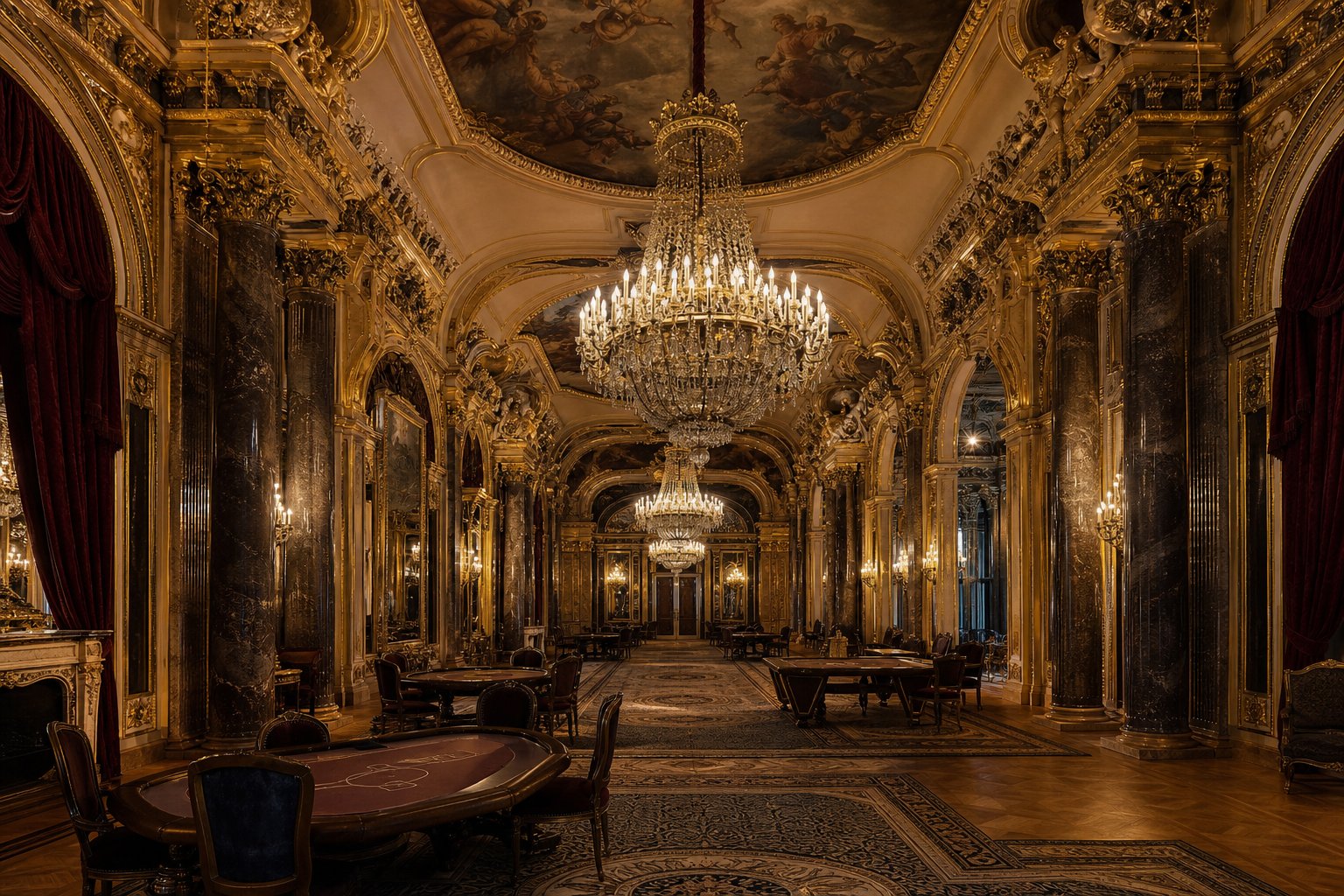
Editorial reconstruction, not a documentary image of a specific Monte Carlo room.
The opera mattered as more than decoration. Programming associated Monte Carlo with music and performance, allowing the destination to claim cultural prestige alongside gaming. Gardens and the Place du Casino extended the interior experience into public space.
A resort economy built on selective access
Monte Carlo’s prosperity rested on a striking division: foreign visitors could enter the gaming rooms, while Monegasque citizens were prohibited. The policy insulated local subjects from direct participation while directing revenue from tourism to the state. In 1869, direct taxation of residents was abolished, reinforcing the casino’s central fiscal symbolism.
Luxury was carefully produced through staff, maintenance and etiquette. Dress codes marked the rooms as exceptional. Currency exchange, private salons and multilingual service supported an international clientele. The property illustrates how service standards can create exclusivity without changing the underlying building.
A stage for myth
Monte Carlo entered novels, journalism and later cinema as shorthand for wealth, espionage and risk. The Monte Carlo method in statistics took its name from the casino’s association with chance, not because the method was created there. Rallying and motor racing added modern technology to the principality’s Belle Époque identity.
Continuity, conservation and change
The complex has changed through restoration, technical modernization and shifting visitor expectations. Historic interiors must accommodate fire safety, accessibility, climate control, security and communications without losing architectural character. This tension is common to operating heritage sites: preservation cannot freeze a working building at one date.
Monte Carlo’s greatest influence is the coordinated destination model. Modern integrated resorts are vastly larger and serve different publics, but the principle—combine accommodation, entertainment, landscape and controlled spectacle—remains legible.
Monte Carlo became durable because it was never only a gaming room; it was an urban and cultural system.
Independence statement: Talveri Nova is not affiliated with Casino de Monte-Carlo, Société des Bains de Mer or Monaco. This article contains no booking, ticketing or operator links and is published solely for historical education.